The global transition towards renewable energy has accelerated at an unprecedented pace over the last decade, with solar energy, clean energy technology, and renewable energy solutions becoming one of the most popular sources of clean energy.
As solar installations expand rapidly across the world, solar monitoring systems, solar plant monitoring technologies, and IoT-based solar monitoring solutions have become essential for ensuring optimal solar energy generation and operational efficiency.
The International Energy Agency (IEA) has forecasted that solar PV will be the greatest source of electricity production in the world by the year 2050. Nevertheless, along with the ongoing expansion of solar infrastructure, the solar monitoring systems, solar energy monitoring platforms, and cloud-based solar monitoring software that play a crucial part in managing solar plants have not been developing at the same rate. Most of the conventional solar monitoring systems are based on archaic hardware, limited data analytics, AI-powered analytics, and non-uniform infrastructure, which makes them ineffective to operate in the modern solar industry.
To solar operators, investors, and power companies, these restrictions in traditional solar plant monitoring systems may lead to loss of performance, increased cost of operation, and delayed fault identification.
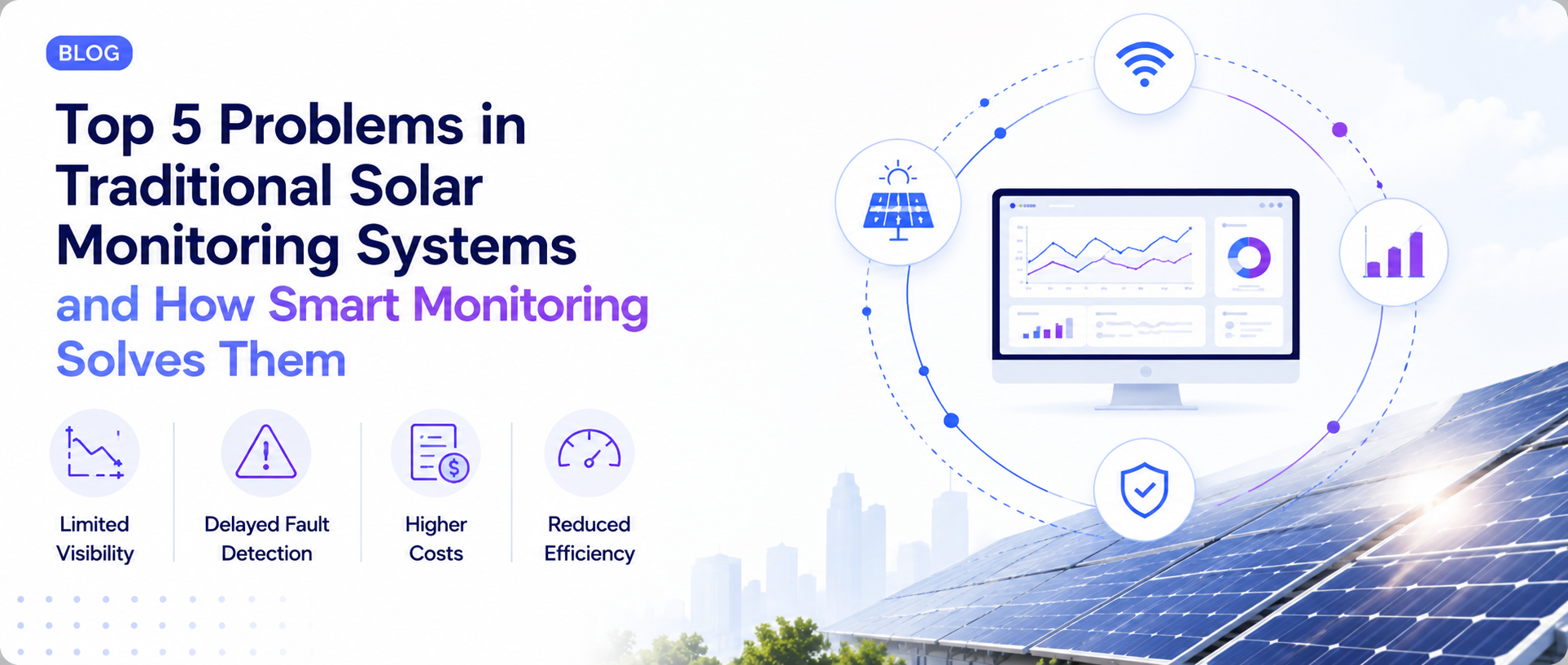
In this blog, we will examine the top five issues related to the use of traditional solar monitoring systems and solar performance monitoring tools and why new smart solar monitoring solutions, AI-driven solar analytics, and digital energy management systems are proving to be imperative in the efficient management of solar assets.
1. Limited Real-Time Data Visibility
The absence of real-time access to the performance of the systems is one of the greatest shortcomings of conventional solar monitoring systems. Traditional solar plant monitoring systems also tend to rely on periodic data logging rather than continuous or real-time remote monitoring, IoT-enabled solar tracking, resulting in operators only getting updated at regular times as opposed to real-time views of solar plant performance. Such a delay may have grave consequences:
- The faults may go unnoticed for hours or days.
- Huge output loss may occur between the period of fault detection and the corrective action taken.
- Maintenance staff are not able to act proactively.
In retrospect, a modern solar monitoring system and solar performance monitoring platform will monitor solar energy output, inverter efficiency, voltage, and efficiency of the system using real-time data analytics and smart grid integration, enabling operators to rapidly detect anomalies.
These problems may not be detected in time unless they are monitored accurately in real-time through smart solar monitoring systems, IoT sensors, and AI-powered monitoring tools, when they cause a serious impact on performance.
2. Lack of efficiency in Fault Detection and Diagnostics
Traditional solar monitoring systems and solar plant monitoring tools usually struggle to identify complicated or slow-moving performance anomalies. These systems generally deal with major equipment-related issues. Nevertheless, several solar performance issues are not very noticeable and are acquired over a period of time:
- Panel degradation
- Dirt accumulation (soiling)
- Vegetation shading
- Cable degradation
The common performance losses are often not identified by the typical monitoring tools lacking predictive maintenance, machine learning algorithms, and advanced fault detection systems. With the lack of advanced diagnostic tools, the operators become aware of the problem when the energy production has reduced considerably.
3. Data Scalability and Management Problems
Modern solar facilities produce large amounts of functional data, such as performance indices, weather analysis, and system faults, often referred to as big data in solar energy systems. Whereas the conventional monitoring systems have not been tailored to such large-scale data environments. Due to the increase in solar installations, these systems encounter major challenges in:
- Data storage
- Data processing
- Connection with analytics devices
Surveys on solar PV monitoring systems emphasise that there is a huge amount of solar data management, cloud computing challenges, and data transmission issues, especially when monitoring various sensors and distributed nodes. In the case of utility-scale solar plants having thousands of panels, these limitations may lead to:
- Data bottlenecks
- Improper performance analysis
- Poor predictive maintenance
To eliminate these scalability problems, modern solar monitoring solutions combining cloud-based platforms, edge computing, and AI analytics are increasingly being introduced.
4. Connection and Communication Problems
Another significant limitation associated with traditional solar monitoring systems is their reliance on a weak communication infrastructure. Most of these systems make use of data loggers, gateways, and wired connections. Nevertheless, the breakdown of this chain of communication may interrupt the whole process of solar monitoring and solar energy monitoring systems, especially in wireless IoT networks and smart energy ecosystems. Some common connectivity challenges include:
- Network outages
- Signal interference
- Hardware malfunctions
- Poor range of wireless transmissions
In the event of these problems, solar operators might temporarily lose visibility, increasing operational risks and affecting solar plant efficiency and energy output optimization.
5. Cybersecurity Vulnerabilities
Cybersecurity has become a significant issue as digital networks continue to integrate more and more with solar monitoring systems and energy monitoring platforms. Several conventional systems lack cybersecurity in renewable energy, secure IoT frameworks, and data protection protocols. According to recent research, thousands of solar power devices remain vulnerable to cyberattacks. Attackers can:
- Manipulate energy production data
- Access sensitive operational data
- Disrupt solar power systems
As solar energy becomes critical infrastructure, cybersecurity in solar monitoring systems and energy infrastructure protection has become increasingly important.
Solar Monitoring is the Next-Gen Solution
The shortcomings of traditional systems point to the emerging demand for smarter, AI-driven, IoT-enabled, and cloud-integrated solar monitoring solutions. Modern systems leverage:
- IoT sensors
- Cloud-based platforms
- Predictive analytics powered by AI
- Advanced cybersecurity frameworks
These innovations enable digital transformation in solar energy, helping operators maximise performance and ROI.
Conclusion
Solar energy remains an important part of the global transition toward sustainable power generation. Nevertheless, traditional systems are proving incapable of meeting modern demands. Organisations that implement next-generation solar monitoring solutions, AI-powered energy analytics, and smart grid technologies gain a competitive advantage.
For forward-looking companies, the future lies in intelligent solar monitoring, digital energy management, and advanced analytics-driven solar operations. If you are looking for a reliable partner to monitor your solar power plant efficiently with real-time solar monitoring, advanced diagnostics, and solar data analytics, partner with AaensaTech today.